Advertising Disclosure
Best Solar Power Banks in 2026? I Tested 4!

Best Solar Power Banks in 2026? I Tested 4!
Writtten and Edited by: Benjamin White
March 30, 2025
Disclosure: We earn a small referral fee on qualifying Amazon purchases — you pay nothing extra, and it helps us keep testing products for you.


EUNOIA™ Cortisol Reduction Capsules
- Most Clinically Studied Ingredients
- Helps manages healthy weight levels
- Naturally improves energy levels



If you love hiking or camping, chances are you’ve brought a portable charger with you. But depending on how much you use your phone—or how long you’re out there—that charger will eventually die.
That’s where solar power banks come in. Each battery bank in this roundup promises to charge your phone anywhere using just the sun — basically unlimited power on the go.
So I picked up some of the best-selling options on Amazon and started testing portable solar chargers to see if they actually deliver on these promises!
If you’d like to watch the video of my testing out these solar power banks, watch here:
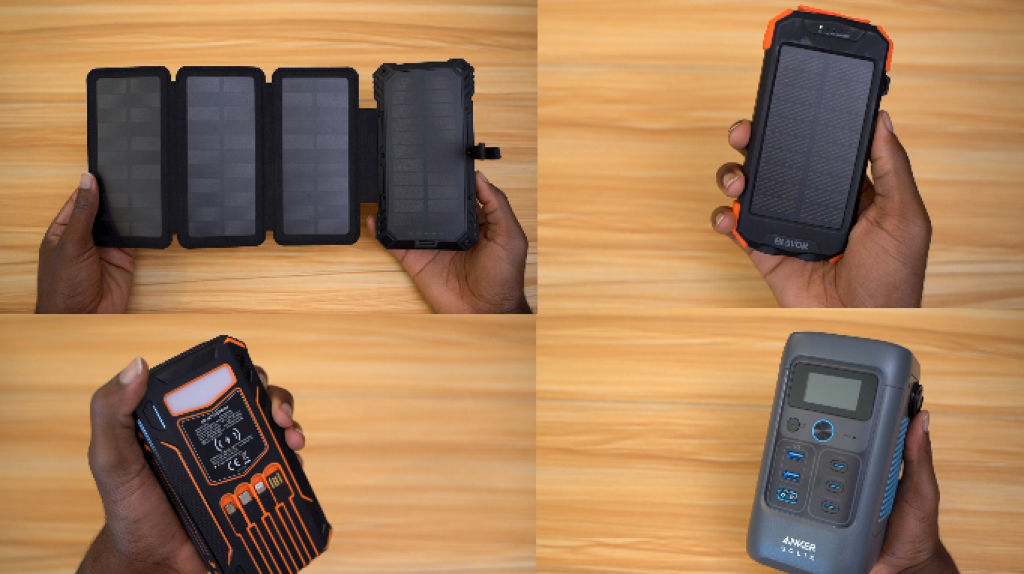
🔋 The Solar Power Banks Tested
A compact 10,000mAh option with:
built-in internal battery
20W USB-C fast charging
Wireless charging – charges up to three devices simultaneously
Flashlight + compass
Waterproof + shock-resistant design
This one is small and budget-friendly—but we’ll see how it performs.
This one stands out right away with:
4 solar panels
48,000mAh claimed capacity
Built-in cables
Multi-device charging
The goal here is faster solar charging and more versatility.
On paper, this one looks stacked:
49,800mAh claimed capacity
4 solar panels
Built-in cables + wireless charging
Flashlight + carabiner
Highest capacity so far—but does it actually translate to performance?
This one is in a different category:
~60,000mAh equivalent (192Wh)
Up to 140W output
Multiple ports
Recharge via wall, car, or solar
This is the premium option… so it better perform like one.
How to Choose a Solar Power Bank
With so many options on the market, here are the key factors worth paying attention to before you buy:
Battery Capacity (mAh)
The higher the mAh the more charge you get but claimed numbers are often inflated. A 10,000mAh unit is enough for day trips and light phone charging. Go for 40,000mAh and above for multi-day camping or charging larger devices. Keep in mind solar chargers come in two forms: ones with a built-in battery (like all four tested here) that store power for later, and standalone panels without one, which need to be paired with a separate power bank to actually hold a charge.
Solar Panel Quality
More solar panels doesn’t always mean better performance. What matters more is panel efficiency and direct sunlight access. Efficiency is measured as watts out divided by watts in, and even under ideal conditions, real-world solar panels rarely exceed 14%. That’s why solar charging works best as a backup top-up rather than your primary power source. To boost output, angle your solar panel so it sits directly perpendicular to the sun. Solar panels tilted away from direct sunlight lose efficiency fast, even on a clear day.
Solar Panel Types
Not all solar chargers work the same way. Some have a built-in battery that stores energy for later use — this is what all four units in this test use. Others are just panels without a battery, meaning you need a separate power bank to store the energy they generate. Panels are also either integrated (one-piece unit) or foldable (separate panels connected to a battery). Most quality solar chargers use monocrystalline silicon panels, the industry standard, capable of up to 21% efficiency.
Charging Speed
Look at watt output not just capacity. Budget power banks typically deliver 6 to 8W through built-in cables. Using your own USB-C cable can push that significantly higher — in our testing it made a noticeable difference across multiple units.
Ports and Device Compatibility
Think about how many devices you need to charge and what ports they use. USB-C charges faster, wireless charging is convenient but slower, and built-in cables reduce clutter but can limit speed.
Durability
For outdoor use look for at least an IPX4 waterproof rating and shockproof construction — especially if you’re taking it hiking or camping where drops and rain are a real possibility.
Price vs. Performance
A higher price tag doesn’t always guarantee better real-world performance. Budget options can overdeliver when used correctly while premium power stations justify their cost with significantly faster charging and better solar output. Know what you need before spending more than necessary.
🔌 Charging Speed Test Results
I used a USB digital tester to measure watt output and tracked battery gain after 3 minutes.

Built-In Cable Performance
| Power Bank | Watt Output | Battery Gain (3 min) |
|---|---|---|
| BLAVOR | 6-7W | +3% |
| SOARAISE | 7.19W | +3% |
| KEPSWIN | 7.12W | +3% |
| ANKER (no solar) | 16.9W | +6% |
| ANKER (with solar) | 20W | +7% |
Using My Own USB-C Cable
| Power Bank | Watt Output | Battery Gain (3 min) |
|---|---|---|
| BLAVOR | ~18W | +5% |
| SOARAISE | ~8W | +4% |
| KEPSWIN | ~18W | +7% |
🔑 Key Takeaway:
If you take ONE thing from this test:
👉 Use your own cable.
It makes a huge difference—especially for the Blavor and Kepswin.
🔋 Multi-Device Charging Test
We tested how each power bank performs when charging multiple devices through its USB ports simultaneously — a phone and iPad at the same time.

| Power Bank | Single Device | With Second Device | Performance |
|---|---|---|---|
| BLAVOR | 17W | 7W | Big drop |
| SOARAISE | 7W | 6W | Slight drop |
| KEPSWIN | 7W | 7W | Holds steady |
| ANKER | 17W | 13W | Still strong |
Using My Own USB-C Cable
| Power Bank | Watt Output | Battery Gain (3 min) |
|---|---|---|
| BLAVOR | ~18W | +5% |
| SOARAISE | ~8W | +4% |
| KEPSWIN | ~18W | +7% |
🔑 Key Takeaway:
Anker is still the fastest—even when sharing power. If you’re charging a phone and tablet simultaneously, nothing here comes close.
Kepswin is the most stable which is impressive for its price point. Curious how it stacks up overall? Find out in this KEPSWIN 49800mAh review.
Blavor drops off hard under load. It is best kept for single-device use — power drops noticeably once you plug in a second device.
☀️ Solar Charging Test (2 Hours)

Two hours of direct sunlight is a fair benchmark for real-world solar power generation. Here’s how much power each unit actually generated during our test.
| Power Bank | Starting Level | Ending Level | Gain |
|---|---|---|---|
| BLAVOR | Low | ~25% (1 bar) | +1 bar |
| SOARAISE | 50% | 75% | +1 bar |
| KEPSWIN | 1 bar | 1 bar | Almost none |
| ANKER | ~60% | 100% | ~+40% |
🔑 Key Takeaway:
- 🥇 Anker dominated solar charging by a wide margin which is not surprising for the premium pick.
- 🥈 Blavor and Soaraise landed about the same. If you’d like to know more on whether the SOARAISE is worth the price over other solar power banks, check out this SOARAISE 48000mAh review.
- 🥉 Kepswin struggled the most despite having four solar panels.
🧱 Durability Test

I dropped each one to see if they could handle real-world use.
| Power Bank | Result |
|---|---|
| BLAVOR | No issues |
| SOARAISE | No issues |
| KEPSWIN | Still works (rough impact) |
| ANKER | Scratches, but fully functional |
🔑 Key Takeaway:
👉 All passed. No failures.
🏆 Final Verdict: Which One Should You Buy?

Fastest charging (by far)
Best solar performance
Handles multiple devices easily
If you want the best—and don’t mind paying for it—this is the one. I cover everything you need to know in my complete Anker SOLIX C200 buyer’s guide.

Great value for the price
Strong performance with your own cable
- Compact + durable
This is the one most people should probably get.
A compact, affordable battery pack that punches above its weight when you use your own cable. It passed the drop test, hits 18W with the right cable, and costs a fraction of what the Anker runs. For most casual users, it does the job well enough.
See if it’s right for you in my detailed BLAVOR PN-W05 review.
Now I’m curious— which one would you choose?
How long does it take to fully charge a solar power bank using sunlight?
Directly tied to your solar test results and one of the most common pre-purchase questions. Your 2-hour test data answers this honestly.
Can a solar power bank charge two devices at the same time?
Your multi-device test covers this exactly — high search intent from users who want to charge a phone and tablet simultaneously.
Does the built-in cable make a difference for charging speed?
Your test showed a significant gap between built-in and personal cables — this is a unique, test-backed answer most articles don’t have.
Are solar power banks worth it for hiking and camping?
Broad but high-volume question that matches the article’s target audience and opening premise perfectly.
What is the best solar power bank for the money?
Captures budget-focused searchers and lets you highlight BLAVOR as the budget pick and Anker as the premium pick.
Can a solar power bank charge a laptop or tablet?
High-intent question, especially relevant given the Anker’s 140W output — naturally differentiates the products by use case.