Advertising Disclosure
The 3 Best White Noise Machines of 2026 — and the One That Also Wakes You Up
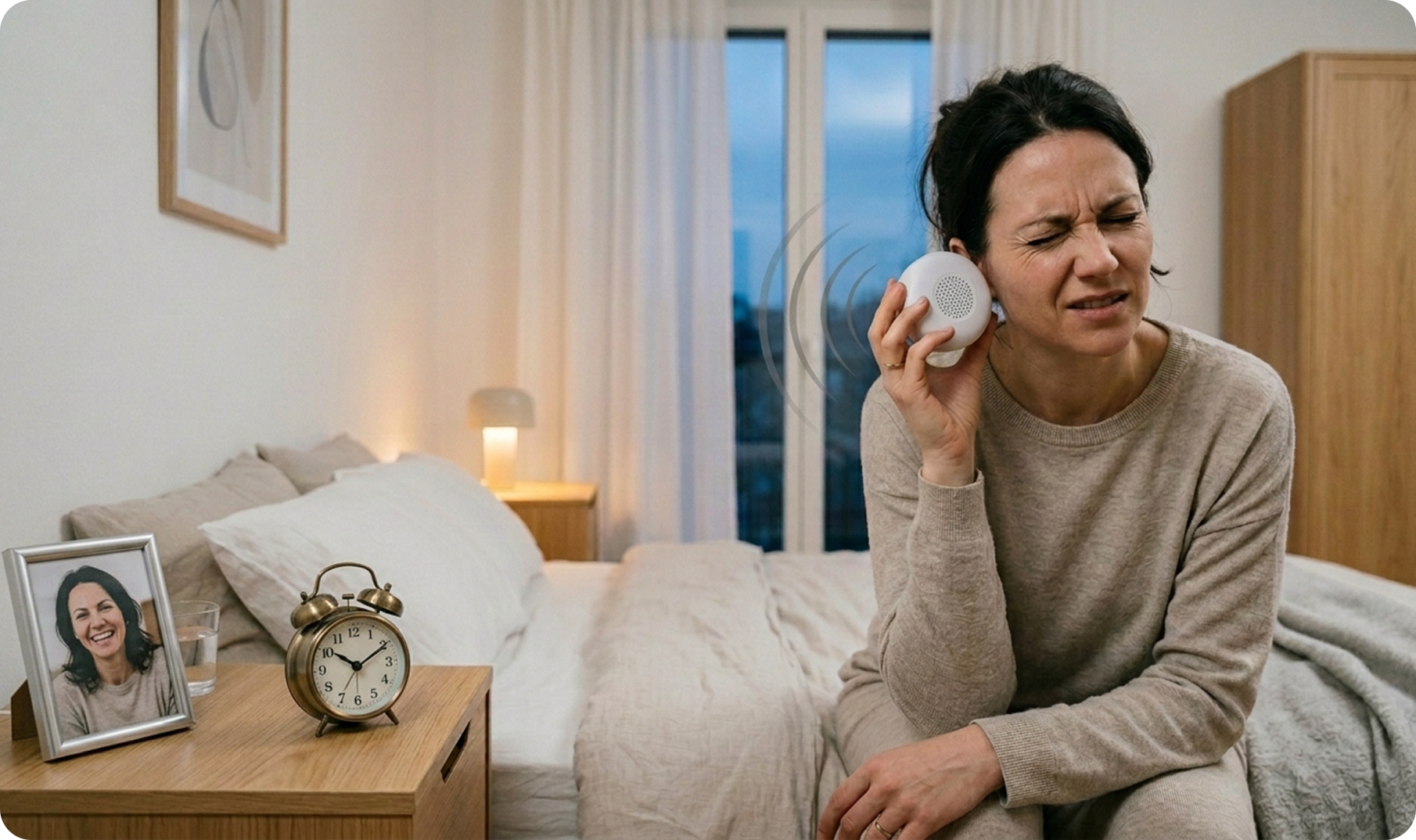
The 3 Best White Noise Machines of 2026 — and the One That Also Wakes You Up
We ran 15 sound machines against real bedroom noise for 90 nights. Most failed the same test.

Reviewed by:
Dr. Christina Hanes — Sleep Specialist
October 16, 2026
Reviewed and Edited by: SA Editorial Team
If You Have Shopped For One of These, You Know The Problem
You are not shopping for "better sleep." You are trying to stop hearing one specific thing.
The person upstairs who crosses the room at 1 a.m. The truck outside your window. The partner beside you who has started snoring. You cannot fix any of it at the source. You cannot soundproof a rental. You cannot make your neighbor buy a rug.
The noise is out of your control. Covering it is the only move left.
There are hundreds of machines that promise to do that. They run from $20 to $200. They all say the same thing, and the listing page tells you nothing useful.
Most people reading this have already been through two or three. A cheap one from Amazon. A free app. A box fan. Each one helped a little right up until the footsteps started, and you were staring at the ceiling at 2 a.m. again.
The problem was never you. It was the machine, and not for the reason you think.
So we stopped reading listings and started testing.
One note up front. Two of our three picks are fan-based sound machines. They have no light and never claimed to. The third is a 2-in-1 that also works as a sunrise alarm clock. We tested all three on noise, and we tested the one with a light on the light too.
How We Tested
We bought the 15 best-selling white noise machines on Amazon and ran each one for 90 nights in real bedrooms, not a lab.
- Did it mask the noise? We tested each machine against footsteps from above, street traffic, and a snoring partner.
- Did it loop? We recorded each one and looked for the repeat point.
- How loud did it get? Decibels at three feet, at low and high.
- Did it last? We checked on day 30, day 60, and day 90.
- Could you sleep in a dark room with it? We noted every light and display, and whether it could be shut off.
- Did it help you wake up? For the one machine with a light, we timed the sunrise and checked whether it came up before the alarm.
We also read hundreds of customer reviews and checked the manuals and warranty terms.
Why Most of These Machines Fail
They cannot reach the noise you bought them for
Not because they are badly made. Because of physics.
Think about what actually wakes you. Footsteps overhead. Traffic. A snoring partner. Bass through a wall. Every one of those is a low sound.
Now think about the machine on your nightstand. It is a small box with a small speaker. Small speakers cannot make a low sound. They run out somewhere in the middle, and everything below that never comes out.
So the machine covers the noise that was never bothering you and misses the one that is.
When it does not work, people turn it up. That does not add covering power down low. It adds hiss. Now you have the same footsteps plus a louder hiss on top.
This is the real story of the category, and almost nobody says it out loud. It is not build quality. It is frequency range. It is also why people who fail with two machines assume they are the problem. They are not. They bought two machines with the same limit.
They loop
Cheaper digital machines do not make sound. They play a recording — often a 10 or 20 second clip — on repeat, all night.
Most people never notice. Light sleepers notice right away, and then they cannot stop noticing. Reviewers describe the same thing again and again: lying there waiting for the seam, counting the seconds until it comes back around.
A sound machine only works if you can stop paying attention to it.
They do nothing about your morning
This one we did not expect to be writing about.
You can fix the noise and still feel wrecked, because of how the night ends. An alarm in a pitch-black room takes you from deep sleep to wide awake in one second. You feel that for the next hour.
That is the whole reason sunrise alarm clocks exist. The light starts dim and builds until the room is bright, so your body has time to surface before any sound plays.
Fourteen of the fifteen machines we tested do nothing here. One handles both ends of the night. That is the one that won.

#1 — Orca SilentPro
$129.99
$139.99
EARLY BLACK FRIDAY SALE
If you are buying one white noise machine, this is the one.
Orca built it around the problem the rest of the category ignores. Instead of adding more sounds or a nicer app, they put in a real bass driver, a speaker that reaches down to where footsteps, traffic, and snoring live.
The difference is not subtle. Other machines sit on top of the noise you are trying to escape. This one sits at the same depth and covers it. If you have already returned two machines because you could still hear the guy upstairs, this is the only one on the list built for you.
The sound never repeats. It is made continuously instead of played back from a clip, so there is no loop point and no seam for your brain to lock onto.
It runs all night or on a timer. Your choice, every night. No forced shutoff at an hour somebody else picked. A machine going silent at 1 a.m. is its own way of waking you up.
The display dims to fully dark. No glow on the ceiling. Nothing pulling your eye at 3 a.m. A surprising number of expensive machines still get this wrong.
There is no subscription. Every sound is unlocked the day it arrives and stays unlocked. No premium tier, no paid sound library, no account. More on why that matters below.
And then it does something none of the others do
At bedtime, the light fades down like a sunset. The room dims a little at a time instead of snapping to black. That fade becomes a cue — put the phone down, stop running tomorrow in your head.
In the morning it comes back up like a sunrise, building before the alarm sounds. You wake to light first and sound second. That is the difference between waking up and being woken up.
If you have been pricing a sound machine and a wake-up light as two separate buys, this is both, on one cord.
And is a 2-in-1 just a device that does two things badly? Often, yes. We expected that going in. So we tested the light on its own terms — how long the ramp runs, how bright it gets at the pillow, whether it really fades at night. Our numbers are in the testing section. Check them against any single-purpose wake-up light.
PROS:

Real bass that actually masks — reaches the low sound other machines cannot
True non-looping sound — continuous, not a short clip on repeat
Runs all night or on a timer — your call
Display dims to fully dark
Sunrise and sunset light — nothing else here does this
Weekday and weekend alarms, set once
No subscription — every sound is yours forever
CONS:

High demand; goes out of stock quickly
Only available online
Best for:
If you can hear your upstairs neighbor. This is the buyer the category has failed hardest. Footsteps are low sound, and low sound is what small machines cannot touch.
If your partner snores. Deeper sound covers snoring better than thin hiss, and you do not have to run it painfully loud. One caution we would rather say than skip: a sound machine handles moderate snoring well. If the snoring comes with gasping or long pauses, that is worth a doctor's visit, not a purchase.
If your alarm goes off while it is still dark. Shift workers and early commuters. For you the sunrise is the reason to buy it, and the masking is the bonus.
If there is a new baby in the house. It works, with one rule that applies to every machine in this category: keep the volume down and keep it well away from the crib. Pediatric guidance is about 50 decibels or lower, several feet from where the baby sleeps.

#2 — SNOOZ Original
Price: $99.99
A real fan in a box, and it does that one thing beautifully
Main Strength
SNOOZ took a different route. There is an actual fan spinning inside the housing. No recording, no speaker, no digital anything.
That solves the looping problem outright. A real fan cannot repeat itself.
It is well made. Twist the shell to change the tone from a deep whoosh to a brighter hiss. Ten volume levels, so it gets properly loud. At about 1.1 lb, it travels well. And the app is free and optional.
Where it falls short is the same place most of the category does: bass. One independent tester found it masked distant traffic easily but noted that some bass still got through at higher volume. It solves volume. It does not solve depth.
It also does nothing for your morning. No light, no alarm. SNOOZ has never claimed otherwise.
PROS:
Compact and light enough for a carry-on
Good warranty and a risk-free trial
No subscription
Ten volume levels with adjustable tone
Genuinely non-looping — it is a real fan
CONS:
Expensive for what it is
Bluetooth drops connection — the most repeated complaint
One sound only — no rain, no brown noise
Some owners report a rattle after weeks of use
No light and no alarm
Best For:
Fan-sound purists and frequent travelers. This buyer has always slept with a box fan and wants that exact sound without the draft or the dust. It is also popular with people who value fine volume control for tinnitus.

#3 — Yogasleep Dohm Classic
Price: $49.99
The 1962 original. Still going.
Main Strength
The Dohm invented this category. It has been in production since 1962, it is hand-assembled in North Carolina, and it is almost all mechanical — a two-speed motor turning a fan inside a plastic dome.
That simplicity is the whole appeal.
There are no lights at all. No display, no indicator, no glow. For people who sleep in real darkness, that alone sells it. The trade is that there is no light in the morning either. The Dohm gets you to sleep and then leaves.
It can also be repaired. Owners open them up to fix rattles and clean out dust. That is rare enough now to be worth mentioning. And it is $49.99, which ends the conversation for a lot of buyers.
The limits are real. It is the quietest machine here by a wide margin, and reviewers say so directly. It is a mid-frequency machine, so footsteps and traffic go straight through it.
PROS:
Simple — plug it in, flip a switch, done
Repairable
No lights at all, which nothing else here offers
Cheapest by a wide margin
CONS:
Weak sound — the quietest we tested, and the most common complaint
Some owners hear the motor itself, especially on high
A minority of units fail inside the first year
No timer and no auto-shutoff
No low-frequency masking, no alarm, no wake-up light
Best for:
Simplicity buyers, dark-room sleepers, and nurseries. It also suits quieter homes — houses rather than apartments — where you want a gentle background hush rather than masking one specific noise.
What About Hatch?
Fair question, because it is probably the one you already looked at.
Hatch Restore is the best-known device in this space, and it does some things well. The light is pleasant, the app is polished, and it looks good on a nightstand. It is not in our top three for one reason.
You buy the device, and then you keep paying. The hardware runs about $169.99, and a subscription for the fuller sound library runs about $4.99 a month or $49.99 a year. Owners also report that it leans heavily on the app and Wi-Fi to do much of anything.
We do not think that is a scandal. But it changes the math. Over three years, a subscription costs more than a second machine.
It is also why we checked the fine print on all three picks. None of them charge a subscription. That should be the default in this category. Increasingly, it is not.
Quick Comparison
Price
$129.99
$99.99
$49.99
Real bass that masks
✅ Yes
❌ Bass leaks through
❌ Mid-frequency only
True non-looping sound
✅ Continuously generated
✅ Real fan
✅ Real fan
All night or timer
✅ Both, on the device
⚠️ Timer via app only
❌ No timer
Dimmable display
✅ Dims to fully dark
⚠️ Dim nightlight
✅ No lights at all
Number of sounds
Multiple
1
1
Subscription
✅ None
✅ None
✅ None
App required
Free app
⚠️ For timer and scheduling
✅ No
Sunrise wake-up light
✅ Builds before the alarm
❌ Not a light product
❌ Not a light product
Sunset wind-down light
✅ Fades as you fall asleep
❌ Not a light product
❌ Not a light product
Alarm clock
✅ Weekday and weekend
❌ None
❌ None
Orca SilentPro
Price
$129.99
Real bass that masks
✅ Yes
True non-looping sound
✅ Continuously generated
All night or timer
✅ Both, on the device
Dimmable display
✅ Dims to fully dark
Number of sounds
Multiple
Subscription
✅ None
App required
Free app
Sunrise wake-up light
✅ Builds before the alarm
Sunset wind-down light
✅ Fades as you fall asleep
Alarm clock
✅ Weekday and weekend
SNOOZ Original
Price
$99.99
Real bass that masks
❌ Bass leaks through
True non-looping sound
✅ Real fan
All night or timer
⚠️ Timer via app only
Dimmable display
⚠️ Dim nightlight
Number of sounds
1
Subscription
✅ None
App required
⚠️ For timer and scheduling
Sunrise wake-up light
❌ Not a light product
Sunset wind-down light
❌ Not a light product
Alarm clock
❌ None
Yogasleep Dohm Classic
Price
$49.99
Real bass that masks
❌ Mid-frequency only
True non-looping sound
✅ Real fan
All night or timer
❌ No timer
Dimmable display
✅ No lights at all
Number of sounds
1
Subscription
✅ None
App required
✅ No
Sunrise wake-up light
❌ Not a light product
Sunset wind-down light
❌ Not a light product
Alarm clock
❌ None
So Which One Should You Buy?
All three beat the twelve we set aside. Any of them will make your room quieter tonight.
The question is not which is best. It is what you are actually trying to fix.
Buy the Dohm if you want simplicity and a truly dark room, and the noise is mild. At $49.99 it is the best value here. Just know it is the quietest on the list, and it will not touch footsteps or traffic.
Buy SNOOZ if you love fan sound specifically. It is louder than the Dohm and better built, and it travels well. But you are paying $99.99 for one sound, the Bluetooth is unreliable, and it still cannot reach the low end.
Buy the Orca SilentPro if the thing keeping you awake is a specific noise you cannot do anything about. It is the most expensive of the three and we will not pretend otherwise. It is also the only one that fixes what this category gets wrong — and the only one that also gets you up gently in the morning.
Every machine here covers mid-range sound. Only one reaches down to the frequencies that actually pull you out of sleep.
So: if your problem is a general hush, buy the Dohm and keep the hundred dollars.
If your problem is the person upstairs, the person beside you, or an alarm that goes off in the dark — nothing else on this list will fix it. You have probably already proved that to yourself twice.
Tell Us What Worked For You
We are always testing, and reader mail shapes what we look at next. If you found a machine that finally solved a noise problem — or one that promised a lot and did not deliver — we would like to hear about it.
A lot of what we cover starts as an email from someone who was tired of not sleeping.